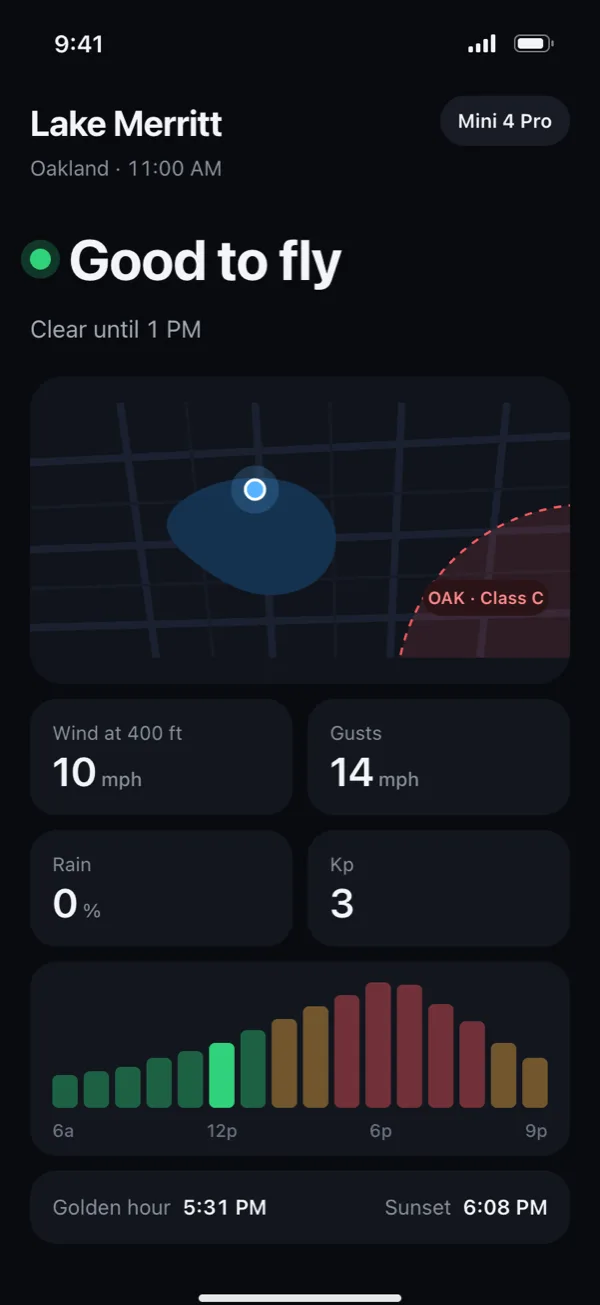
Wind speed at 400 feet
The forecast gives the wind at 33 ft. Your drone flies up to 400 ft, where it's stronger, and by how much depends on the ground below and the time of day.
Why the forecast reads low
Weather stations measure wind 10 m (33 ft) above the ground, the standard height set by the World Meteorological Organization, and weather apps show that number. Near the ground, trees, buildings and the terrain itself slow the air down. Higher up there's less in the way, so the wind is faster.
How much stronger at 400 ft
A common estimate is the power law: wind at 400 ft = wind at 33 ft × 12α, since 400 ft is 12 times higher. The exponent α grows with rougher ground and with calmer, more stable air. For a forecast of 10 mph:
| Where and when | α | At 400 ft |
|---|---|---|
| Open water or flat coast, daytime | 0.10 | 13 mph ×1.3 |
| Open flat land, breezy or overcast | 0.16 | 15 mph ×1.5 |
| Towns and suburbs | 0.34 | 23 mph ×2.3 |
| Flat land, still air at dawn or dusk | 0.40 | 27 mph ×2.7 |
Exponents are typical values for each kind of ground and air (wind gradient). Real air varies, so treat them as a range, not a reading.
What it means for a flight
A 10 mph forecast sounds easy for any drone. Over a town, that can be 23 mph at 400 ft, right at the 24 mph limit of a DJI Mini 4 Pro, before gusts. Wind limits for each drone.
The still air of early morning and evening hides the most. It feels calm on the ground while a stronger flow runs above, and the drone meets it as it climbs.
Read the wind at height
Some forecast models compute wind at 80, 120 and 180 m directly. Good to Fly reads the forecast at 120 m (400 ft) instead of estimating it from the ground.
In the air, watch the wind warning in your drone's app, and climb in steps instead of going straight to 400 ft.
Updated October 29, 2026